
Tony Campbell added a new photo to the album: Greek.
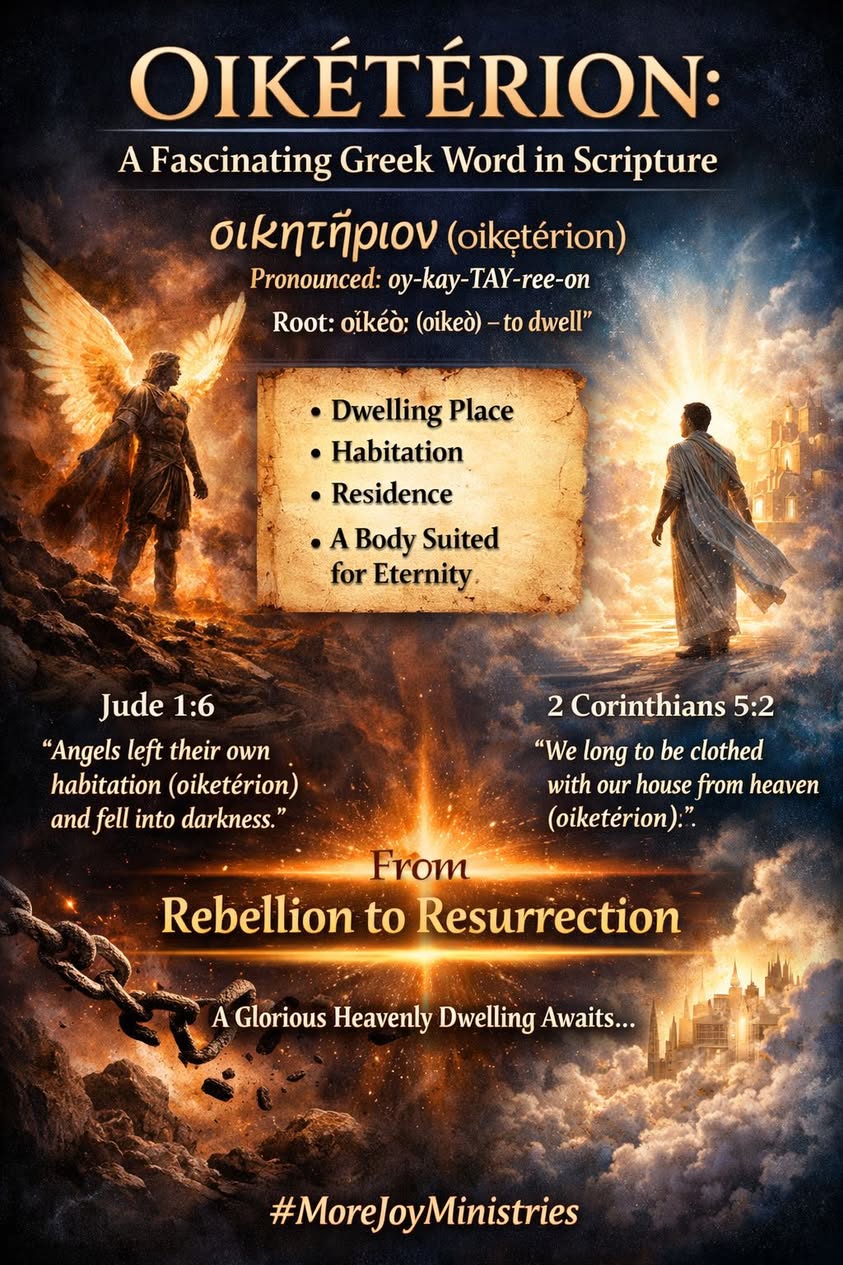
GreekOIKĒTĒRION: (A Fascinating Greek Word in Scripture) The Greek word οἰκητήριον (oikētērion) appears only twice in the entire New Testament, yet it opens the door to a powerful theological insig
GreekOIKĒTĒRION:
(A Fascinating Greek Word in Scripture)
The Greek word οἰκητήριον (oikētērion) appears only twice in the entire New Testament, yet it opens the door to a powerful theological insight about the nature of angels, humanity, and our future resurrection.
Let’s look at it closely.
The Greek Word οἰκητήριον (oikētērion) Pronounced: oy-kay-TAY-ree-on
Root word: οἰκέω (oikeō) – meaning to dwell or inhabit.
Meaning:
- dwelling place
- habitation
- residence
- a body suited for habitation
It refers not just to a house, but a proper dwelling suited for the being that lives inside it.
Where It Appears in Scripture:
The word appears only in two passages.
- Jude 1:6 “And the angels which kept not their first estate, but left their own habitation (oikētērion), he hath reserved in everlasting chains under darkness unto the judgment of the great day.”
Here the word describes the proper dwelling or state of existence assigned to angels.
Jude says certain angels abandoned it.
They left the realm or form God assigned to them.
This verse is widely connected with Genesis 6, where the “sons of God” interacted with human women before the flood.
- 2 Corinthians 5:2 “For in this we groan, earnestly desiring to be clothed upon with our house which is from heaven.”
The phrase “house from heaven” is the same Greek word:
oikētērion
Here it refers to the resurrection body believers will receive.
Paul describes it as a heavenly dwelling for the soul.
The Incredible Contrast:
The same word is used in two opposite ways.
Angels in Jude left their oikētērion.
Believers in Corinthians long to receive their oikētērion.
One abandoned what God designed.
The other longs to receive what God promises.
What This Suggests:
Scripture may be hinting that both angels and humans possess forms suited to their realm of existence.
Angels were created for a heavenly domain.
Humans were created for an earthly body.
But believers will one day receive a glorified heavenly body.
Paul explains this transformation in 1 Corinthians 15:
“It is sown a natural body; it is raised a spiritual body.”
Why This Matters:
The Bible consistently teaches that God establishes boundaries within creation.
Angels have their realm. Humans have theirs. Bodies correspond to those realms.
Jude warns that when those boundaries are violated, judgment follows.
But Paul reminds believers that our future is not limited to the current physical body.
We are destined for something greater.
A heavenly dwelling prepared by God.
The Hope of the Believer:
While rebellious angels abandoned their habitation, believers eagerly await theirs.
One act led to chains and judgment.
The other leads to resurrection and glory.
The same Greek word quietly connects both stories.
And it reminds us that the story of redemption is not just about forgiveness.
It is about transformation into the dwelling God designed for eternity.
- @[61583539981347:2048:More Joy Ministries]
#MoreJoyMinistriesOIKĒTĒRION: (A Fascinating Greek Word in Scripture) The Greek word οἰκητήριον (oikētērion) appears only twice in the entire New Testament, yet it opens the door to a powerful theological insight about the nature of angels, humanity, and our future resurrection. Let’s look at it closely. The Greek Word οἰκητήριον (oikētērion) Pronounced: oy-kay-TAY-ree-on Root word: οἰκέω (oikeō) – meaning to dwell or inhabit. Meaning: - dwelling place - habitation - residence - a body suited for habitation It refers not just to a house, but a proper dwelling suited for the being that lives inside it. Where It Appears in Scripture: The word appears only in two passages. 1. Jude 1:6 “And the angels which kept not their first estate, but left their own habitation (oikētērion), he hath reserved in everlasting chains under darkness unto the judgment of the great day.” Here the word describes the proper dwelling or state of existence assigned to angels. Jude says certain angels abandoned it. They left the realm or form God assigned to them. This verse is widely connected with Genesis 6, where the “sons of God” interacted with human women before the flood. 2. 2 Corinthians 5:2 “For in this we groan, earnestly desiring to be clothed upon with our house which is from heaven.” The phrase “house from heaven” is the same Greek word: oikētērion Here it refers to the resurrection body believers will receive. Paul describes it as a heavenly dwelling for the soul. The Incredible Contrast: The same word is used in two opposite ways. Angels in Jude left their oikētērion. Believers in Corinthians long to receive their oikētērion. One abandoned what God designed. The other longs to receive what God promises. What This Suggests: Scripture may be hinting that both angels and humans possess forms suited to their realm of existence. Angels were created for a heavenly domain. Humans were created for an earthly body. But believers will one day receive a glorified heavenly